ICAO Space Weather Information Service
The International Civil Aviation Organization (ICAO), a specialized agency of the United Nations, began using space weather information to support safe operation of civil aviation on November 7, 2019. ICAO recognizes the importance of space weather forecasting in the civil aviation operations primarily from the following three perspectives: (1) to avoid disruptions to high-frequency (HF) radio communications and satellite communications between aircraft and air traffic control, (2) to prevent navigation errors caused by satellite-based positioning systems, and (3) to reduce space radiation exposure for aircraft crews. To provide this information worldwide, ICAO has designated four organizations as ICAO global Space Weather Centers: the United States (SWPC), the European consortium (PECASUS), the Australia-Canada-France-Japan consortium (ACFJ), and the China-Russia consortium (CRC). NICT participates as a member of ACFJ and contributes to the operation of the ICAO Space Weather Information Service.
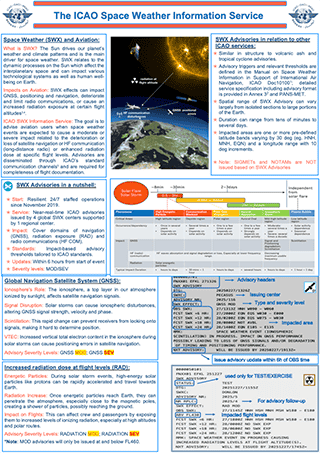
Space weather information related to communications, navigation, and radiation is distributed to aviation organizations in a standardized message format called an Advisory, through international meteorological networks. Within ACFJ, the Australian Bureau of Meteorology and Météo-France issue these Advisories. NICT supports their preparation by providing observation data and the results of model calculations.